How Do You Style a Bone Inlay Dressing Table in a Modern Bedroom?
You can style a bone inlay dressing table in a modern bedroom by keeping the surrounding décor simple, choosing complementary colours, and allowing the handcrafted pattern to remain the main feature. Add practical lighting, a well-proportioned mirror, and only a few useful accessories to create a space that feels elegant without looking overcrowded.
A dressing table can be one of the most personal pieces of furniture in your bedroom. It is where you get ready in the morning, organise everyday essentials, and often keep the small objects you use regularly. But it can also influence how the entire room feels.
When the furniture has a detailed handcrafted finish, you do not need to add lots of decoration around it. The furniture itself already provides visual interest.
That is particularly useful in a modern bedroom. Contemporary interiors tend to work well with clean lines, controlled colour palettes, practical layouts, and carefully selected decorative pieces. A detailed inlay dressing table can introduce craftsmanship and pattern without requiring you to abandon that modern simplicity.
The real challenge is balance.
You want the dressing area to feel beautiful, but you also want it to remain practical. You want the inlay pattern to stand out, but you do not want the room to look visually busy. And you want the dressing table to feel connected to the rest of your bedroom rather than looking like a separate piece that was simply placed against an empty wall.
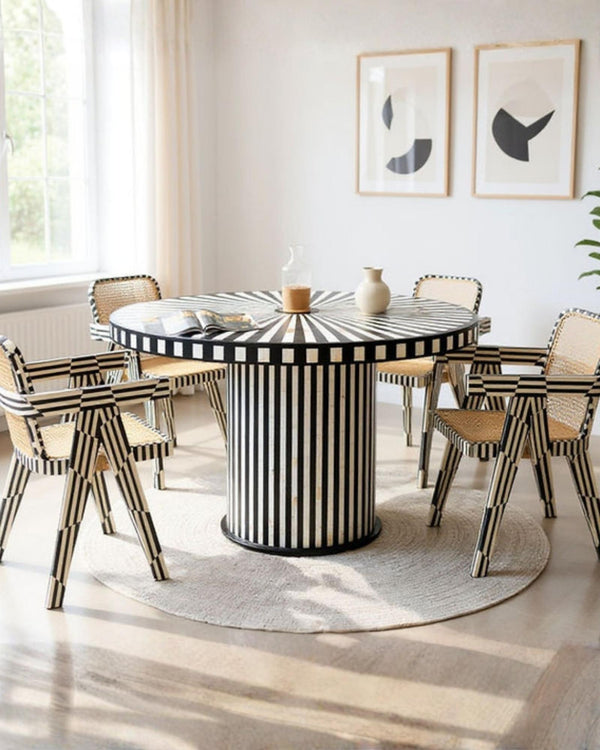
How Do You Style a Bone Inlay Dressing Table in a Modern Bedroom?
The easiest way to style a bone inlay dressing table is to treat it as the visual anchor of your dressing area. Keep the wall, lighting, accessories, and surrounding furniture relatively understated so the craftsmanship remains visible.
Start by choosing the right location.
A dressing table generally works best where you have enough natural or artificial light and enough room to sit comfortably. Avoid squeezing it between large pieces of furniture simply because there is an empty space available.
Before arranging anything, measure:
The available wall width
The depth of the dressing table
Space needed for a chair or stool
Drawer clearance
Walking space around the furniture
Distance from nearby wardrobes and doors
Position of electrical outlets
Once the practical layout works, you can start thinking about style.
Why Does Inlay Furniture Work With Modern Interiors?
Modern design does not necessarily mean that every piece of furniture has to look minimal.
In fact, contrast can make a room more interesting.
A bedroom with a simple upholstered bed, plain walls, neutral bedding, and clean-lined furniture can sometimes benefit from one piece with a stronger decorative identity.
Inlay furniture provides that contrast through its surface.
Traditional bone inlay techniques involve individually shaped pieces being arranged into decorative patterns over a wooden furniture structure. Resin is commonly used to fill the spaces around the inlay, followed by sanding and polishing to create a smooth finished surface. The amount of handwork involved varies according to the design and complexity of the furniture.
This handcrafted quality can prevent a modern bedroom from feeling too uniform.
The trick is not to surround the dressing table with more intricate furniture. Instead, let it provide the decorative detail while the rest of the room supports it.
Start With the Mirror
A mirror is one of the most important elements above a dressing table.
It has an obvious practical purpose, but it also influences the overall composition of the wall.
You can use a bone inlay mirror to continue the handcrafted look above the dressing table. This creates a visual relationship between the furniture and the wall without requiring additional decorative elements.
However, you do not necessarily have to match the mirror and dressing table perfectly.
You can also create contrast.
For example, a simple round mirror can soften a dressing table with strong geometric lines. A rectangular mirror can reinforce a structured modern look. An ornate frame can create a more decorative atmosphere, while a clean-lined frame can keep the overall arrangement contemporary.
The choice depends on the character you want.
When selecting the mirror, pay attention to proportion. A very small mirror above a wide dressing table can look disconnected. A mirror that is excessively large can dominate the furniture below it.
How Do You Choose the Right Mirror Shape?
Think about the shapes already present in your bedroom.
If most of your furniture has straight edges, a curved or rounded mirror can introduce softness.
If your room already contains several curved elements, a rectangular mirror can bring some structure.
You can also use the mirror to balance the proportions of the wall.
For example:
A wide dressing table can work with a horizontally oriented mirror.
A narrow table can suit a vertically oriented mirror.
A compact bedroom can benefit from a mirror that helps reflect available light.
A highly patterned dressing table may look better with a simpler mirror frame.
The goal is not to follow a strict decorating rule. Look at the entire wall and consider whether the mirror feels appropriately scaled.
Keep the Wall Behind the Dressing Table Simple
One of the easiest ways to make an inlay dressing table stand out is to give it a quiet background.
You can use a neutral painted wall in shades such as:
White
Warm cream
Beige
Soft grey
Taupe
Muted earthy tones
If you prefer wallpaper, consider a subtle texture or restrained pattern.
Avoid choosing a wall treatment that competes directly with the inlay pattern unless you intentionally want a maximalist look.
A modern bedroom usually benefits from visual breathing room. When you allow some empty space around the dressing table, the furniture has greater presence.
How Should You Choose the Colour Palette?
The colour of your dressing table should connect naturally with the existing bedroom.
You do not need to match it exactly to the bed, wardrobe, or flooring.
Instead, look for relationships.
If your room has warm beige bedding, an ivory or cream inlay design can blend naturally into the palette.
If your bedroom uses darker furniture, a light inlay piece can provide contrast.
If your walls and textiles are predominantly white, you can introduce a darker background or stronger pattern for definition.
The safest approach is to select one dominant colour and two or three supporting tones.
For example:
Soft neutral bedroom
Cream
Beige
Ivory
Natural wood
Contemporary contrast
White
Charcoal
Black
Warm metallic accents
Earthy bedroom
Olive
Sand
Cream
Natural brown
The important thing is consistency. Your accessories should relate to the palette instead of introducing a new colour with every object.
Add Lighting That Works for You
A dressing table needs good lighting.
Natural daylight is useful during the day, but you should also consider what happens in the evening.
A small table lamp can provide softer illumination than a strong overhead light. Wall lights on either side of the mirror can provide more even illumination, depending on your bedroom's electrical setup.
When choosing lighting, think about both function and appearance.
A modern dressing area might use:
A simple ceramic lamp
A slim metal table lamp
Wall sconces
Integrated mirror lighting
A small sculptural lamp
Avoid placing a very large lamp on a relatively small dressing table. It can take away useful surface area and make the furniture appear visually crowded.
If the dressing table has an intricate pattern, a simpler lamp may be enough.
Use Accessories Carefully
This is where many dressing tables go wrong.
You might have beautiful perfume bottles, jewellery boxes, candles, skincare products, books, decorative trays, and small ornaments. It can be tempting to display everything.
But if you put everything on the surface, the inlay pattern disappears.
Instead, divide the surface into functional zones.
For example:
Everyday zone
Keep the products you use every morning in one small tray.
Decorative zone
Add one vase, artwork, or sculptural object.
Lighting zone
Position your lamp where it provides useful illumination without blocking your mirror.
Personal zone
Leave space for one or two objects that have personal meaning.
This makes the dressing table feel lived-in without becoming cluttered.
Why Does Negative Space Matter?
Negative space is simply the area you intentionally leave empty.
It is particularly important when you have decorative furniture.
Imagine a dressing table covered from edge to edge with objects. Your eyes see the accessories before they see the craftsmanship.
Now remove half of those objects.
Suddenly, the pattern becomes much easier to appreciate.
This is not about having an empty bedroom. It is about deciding what deserves attention.
A useful rule is to arrange your accessories and then remove one or two things. If the surface still feels complete, you probably had more decoration than you needed.
Where Does a Bedroom Chest of Drawers Fit Into the Design?
A dressing table is usually part of a larger storage system.
If you need additional storage, a bedroom chest of drawers can complement the dressing area while keeping clothing and personal belongings organised.
However, avoid creating a bedroom where every piece of furniture has the same decorative intensity.
If your dressing table already has a detailed inlay pattern, you might choose a simpler chest. Alternatively, if the rest of the room is understated, another handcrafted piece can create continuity.
Think about visual weight.
Two pieces can coordinate without being identical.
You can connect them through:
Similar colours
Matching hardware tones
Related patterns
Similar wood tones
Consistent proportions
Repeated shapes
This creates cohesion without turning the bedroom into a matching furniture showroom.
How Can You Style the Dressing Table With a Minimalist Approach?
Minimalism does not mean removing all personality.
It means being selective.
For a minimalist dressing table, you might use:
One mirror
One lamp
One small tray
One decorative object
A few everyday essentials
That may be enough.
The handcrafted pattern becomes the main visual detail.
This approach works particularly well when your bedroom already contains large visual elements such as an upholstered headboard, textured rug, statement artwork, or patterned curtains.
The more visual information already present in the room, the more restrained your dressing area can be.
Can You Use Metallic Accents?
Yes, but use them carefully.
Gold, brass, bronze, and brushed metal can work nicely with ivory, white, cream, black, and natural wood tones.
A small metallic detail can appear in:
Lamp hardware
Drawer handles
Decorative trays
Mirror frames
Jewellery holders
You do not need every metal element to match perfectly, but keeping the finishes reasonably consistent can make the room feel more intentional.
If the dressing table already has a strong pattern, avoid adding too many shiny surfaces. A few subtle metallic details can provide contrast without becoming the focus.
What Type of Seating Works With a Dressing Table?
Your chair or stool should be comfortable enough for everyday use and appropriately scaled to the table.
A low upholstered stool can create a softer appearance. A simple wooden chair can provide contrast. An upholstered accent chair can make the dressing area feel more substantial.
Consider the rest of the bedroom.
If your bed has soft upholstery, repeating a similar fabric at the dressing table can create continuity.
If the room already has plenty of fabric, a simpler chair can introduce balance.
Also consider clearance. You should be able to pull the chair out and sit comfortably without blocking a wardrobe, door, or walking path.
Practical comfort matters just as much as appearance.
How Can You Make a Small Dressing Area Feel Bigger?
A small bedroom does not mean you have to give up on a beautiful dressing area.
Use visual simplicity to your advantage.
A few useful techniques include:
Choose furniture with appropriate depth.
Keep the wall above the table uncluttered.
Use a mirror to reflect light and create visual openness.
Avoid oversized accessories.
Choose furniture with storage that suits your needs.
Keep the floor around the dressing area clear.
Use light colours if you want a brighter appearance.
Do not buy the smallest possible dressing table simply because the bedroom is compact. You still need enough surface space and storage for your routine.
The right size is the smallest piece that comfortably performs the job you need it to do.
How Does Texture Make the Dressing Area More Interesting?
Modern bedrooms can sometimes rely heavily on smooth surfaces. A patterned inlay dressing table introduces another tactile and visual layer.
You can build on this through contrasting textures.
For example:
Smooth inlay
Soft linen
Woven baskets
Plush upholstery
Matte ceramics
Natural wood
Textured rugs
The contrast makes the room feel richer without requiring additional colour.
Texture is especially useful when you prefer neutral interiors. A beige bedroom does not have to look boring if you combine different materials and finishes.
Read More - Unique Bathroom Mirrors: Designs That Elevate Your Space
Should You Match Your Dressing Table With Your Bedside Tables?
Not necessarily.
Matching furniture sets are convenient, but they are not the only way to create a coordinated bedroom.
You can create a more collected appearance by combining related but different pieces.
For example, your dressing table might have a detailed inlay surface while your bedside tables have a plain wood finish.
The connection can come from colour.
Or you might use similar drawer handles.
Or perhaps both pieces share a geometric shape.
The objective is visual harmony rather than perfect duplication.
How Can You Create a Balanced Modern Bedroom?
A balanced bedroom usually has a clear visual hierarchy.
You should be able to identify the main elements without feeling that everything is demanding attention.
Your bed will often remain the largest visual feature. The dressing table can act as a secondary feature. Smaller accessories should support both.
You can think about the room in three levels:
Primary elements
These are your largest pieces:
Bed
Wardrobe
Dressing table
Large rug
Secondary elements
These help connect the main furniture:
Mirror
Bedside tables
Lighting
Chair
Artwork
Accent elements
These add personality:
Books
Vases
Trays
Small decorative objects
Plants
Personal photographs
If every item falls into the accent category, the room can quickly become cluttered.
Can You Use Luxury Dressing Table Mirrors in a Contemporary Bedroom?
Yes. The term luxury does not have to mean excessive decoration.
A well-designed mirror can feel luxurious because of its proportions, craftsmanship, frame, finish, or overall visual quality.
When choosing luxury dressing table mirrors, look beyond the label and consider whether the mirror actually works with your space.
Check:
Frame material
Mirror quality
Overall dimensions
Shape
Mounting requirements
Relationship to the dressing table
Relationship to the rest of the bedroom
A beautiful mirror that is badly proportioned can make the entire dressing area feel awkward.
A simpler mirror that fits the furniture perfectly can often produce a more polished result.
What Role Does Personal Style Play?
There is no single correct way to style an inlay dressing table.
Your routine should influence the design.
If you use the dressing table every morning, prioritise easy access to your everyday items.
If you mainly use it as a decorative vanity, you can leave more of the surface available for artwork and accessories.
If you regularly wear jewellery, include a small organiser.
If you use makeup, consider drawer organisers that keep products separated.
If you work from the dressing table occasionally, make sure the surface can be cleared easily.
Good interior styling is not just about photographs. The furniture should work when you are actually living with it.
How Can You Connect the Bedroom With Other Areas of Your Home?
You do not have to repeat the exact same furniture throughout your home.
Instead, repeat design ideas.
Perhaps your bedroom uses white and cream with handcrafted detailing, while another room uses green and natural wood.
A green dining table can introduce a stronger colour elsewhere in the home while still contributing to a broader palette if green appears in smaller bedroom accents such as cushions, artwork, or plants.
This creates continuity without making every room look identical.
Your home should feel connected, but each room can still have its own identity.
How Do You Keep an Inlay Dressing Table Looking Good?
Handcrafted furniture benefits from consistent, gentle care.
Dust the surface regularly using a soft cloth. If something spills, wipe it promptly rather than allowing moisture to remain on the surface.
Avoid:
Abrasive cleaning materials
Harsh chemicals
Excessive water
Direct prolonged sunlight
Hot objects placed directly on the surface
Dragging heavy accessories across the finish
Tabeer Homes recommends protecting inlay furniture from excessive moisture, heat, prolonged direct sunlight, and abrasive cleaning products. Using suitable protective pads beneath accessories can also reduce the risk of scratches or marks.
The simplest maintenance routine is often the most sustainable one. Take care of small spills immediately and avoid exposing the surface to conditions that can damage it.
What Should You Consider Before Buying an Inlay Dressing Table?
Before making a purchase, look at the furniture from both a design and practical perspective.
1. Measure your space
Do not rely on visual estimation. Measure the available wall and floor space.
2. Think about your routine
Consider what you actually need to store and use.
3. Examine the craftsmanship
Look at the pattern, edges, surface finish, drawer construction, and hardware.
4. Consider the room's colour palette
Choose something that complements the existing colours rather than fighting them.
5. Plan the mirror at the same time
The dressing table and mirror should work together proportionally.
6. Think about lighting
Make sure the area is practical in both daytime and evening.
7. Consider maintenance
Understand how the surface should be cleaned and protected.
These steps help you avoid choosing a piece based purely on appearance.
Read More - Blue Handcrafted Console Tables: A Statement Piece for Your Entryway
Styling Ideas for Different Bedroom Looks
For a Minimalist Bedroom
Use a neutral wall, simple mirror, small lamp, and minimal accessories. Allow the inlay to provide the pattern.
For a Contemporary Bedroom
Pair the dressing table with clean-lined furniture, neutral bedding, modern lighting, and one or two sculptural accessories.
For a Warm Bedroom
Use beige, cream, natural wood, soft textiles, and warm lighting to create a comfortable environment around the detailed furniture.
For a More Dramatic Bedroom
Use stronger wall colours or darker furniture around a lighter inlay piece. Keep accessories controlled so the contrast remains intentional.
For a Soft Feminine Bedroom
Combine the dressing table with curved shapes, soft fabrics, muted colours, and delicate lighting rather than relying on excessive ornamentation.
Final Thoughts
Styling an inlay dressing table in a modern bedroom is mainly about balance. You already have a piece with considerable visual character, so you do not need to surround it with excessive decoration.
Start with the right location and proportions. Choose a mirror that complements the furniture, use lighting that makes the dressing area practical, and keep accessories selective. Then connect the dressing area to the rest of your bedroom through colour, texture, and proportion.
The most successful arrangement is usually not the one with the most decoration. It is the one where every element has a reason to be there.
With handcrafted furniture from Tabeer Homes, the inlay itself can become part of that reason. Let the pattern remain visible, give the piece enough space, and build the rest of the room around it rather than trying to make every element compete for attention.
Frequently Asked Questions
Is a bone inlay dressing table suitable for a modern bedroom?
Yes. Its handcrafted pattern can create an attractive contrast with modern furniture, neutral colours, clean lines, and contemporary lighting.
What mirror should you use with an inlay dressing table?
Choose a mirror based on the size, shape, and pattern of your dressing table. A simple mirror can balance an intricate table, while a decorative mirror can create a more layered look.
How do you keep a dressing table from looking cluttered?
Limit the number of items on the surface and group everyday products together in a small tray or organiser. Leave enough visible space for the inlay pattern to remain a noticeable feature.
What colours work with bone inlay furniture?
White, ivory, cream, beige, grey, natural wood, and muted earthy colours can work well. Darker shades can also create contrast with lighter inlay designs.
Can you mix bone inlay furniture with modern furniture?
Yes. Inlay furniture can work particularly well with clean-lined modern pieces because the contrast between handcrafted detail and simple forms creates visual interest.
Should your dressing table match your bedroom chest of drawers?
It does not have to match exactly. You can coordinate the pieces through colour, hardware, shape, material, or overall style.
How do you care for an inlay dressing table?
Use a soft cloth for regular dusting, clean spills promptly, and avoid abrasive cleaners, excessive moisture, heat, and prolonged direct sunlight.
Can a dressing table work in a small bedroom?
Yes. Choose a proportionate design that leaves enough room for comfortable movement and chair clearance. A suitable mirror can also help make the area feel more open.
What should you keep on a dressing table?
Keep only the items you regularly use or genuinely want to display. A lamp, mirror, small tray, organiser, vase, or a few personal objects can be enough.
Is handcrafted variation normal in bone inlay furniture?
Yes. Individually shaped and placed inlay pieces can have small variations. These differences are part of the handmade character of the furniture.


Comments
Post a Comment